
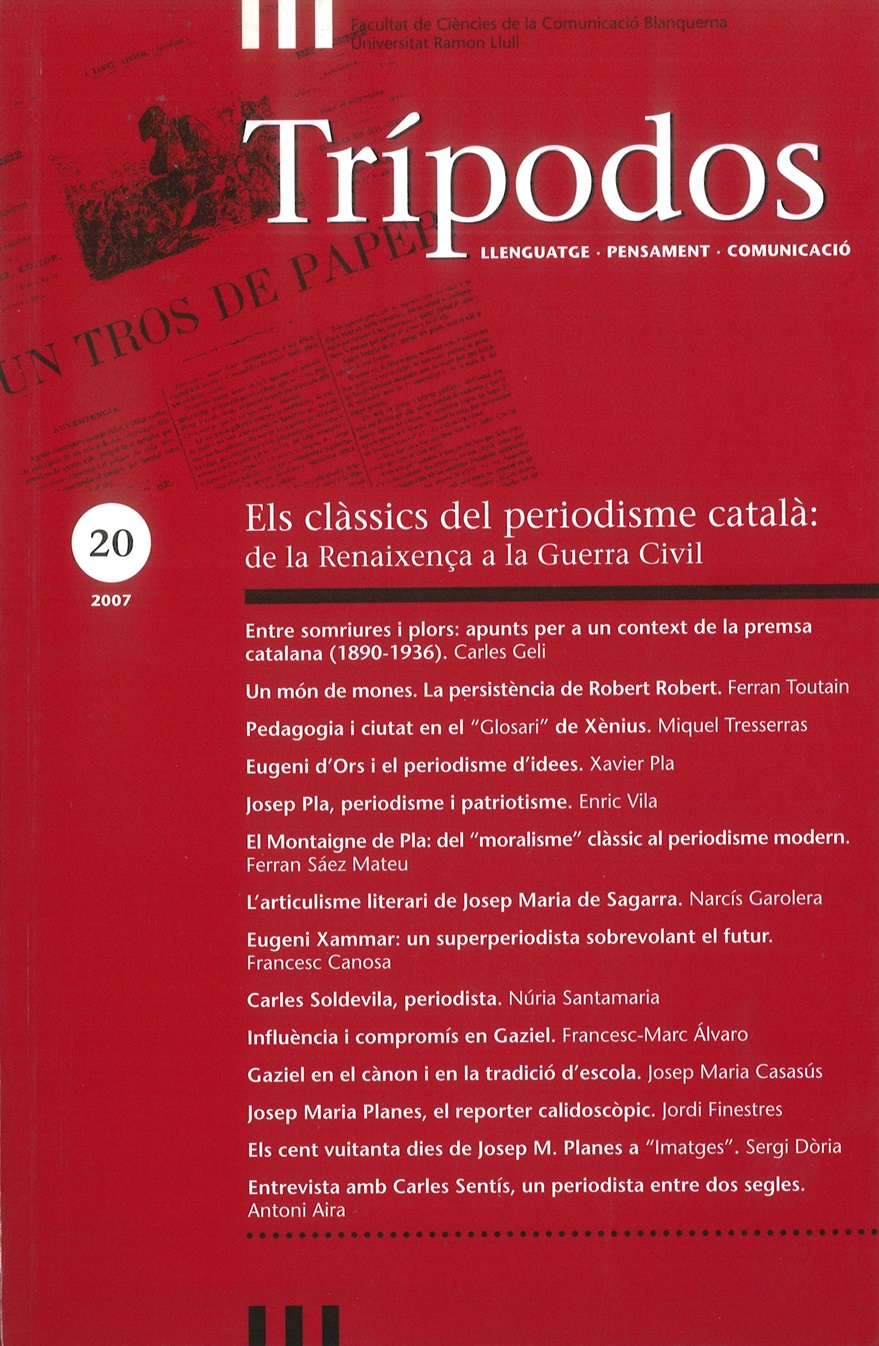
El Montaigne de Pla: del "moralisme" clàssic al periodisme modern
DOI:
https://doi.org/10.51698/tripodos.2007.20.49-62Abstract
The current concept of “moralism”, or even of the term “moral”, has undergone a complex semantic evolution which started in the dying moments of the ancient world and continues today. The turning point of this transformation can be found in the work of Michel de Montaigne (1533-1592), whom great academics such as Hugo Friedrich described as “post-antique”. Some authors of the 20th century, such as Pla and Zweig, revived or accepted the perspective of Montaigne. For obvious reasons, this revival turned out to be wrong, in that it juxtaposed two nearly contradictory meanings of the concept of “moral”. This confusion has generated some extraordinarily erroneous writing about the nature and, above all, the intentions of writers such as Josep Pla. In this article we include texts that show the danger of juxtaposing the two meanings of the word “moral” in the work of certain 20th century authors such as Pla.
Downloads
Downloads
Published
How to Cite
Issue
Section
License
Copyright (c) 2006 Tripodos

This work is licensed under a Creative Commons Attribution-NonCommercial-ShareAlike 4.0 International License.
Once an article has been approved for publication in Tripodos, the exclusive right to publish the work becomes the property of Blanquerna School of Communication and International Relations of Ramon Llull University. These rights can be granted to a third party with the agreement of the author(s).
Until the articles have been approved for publication, Blanquerna School of Communication and International Relations of Ramon Llull University has no rights over them.
The submission of articles is understood to represent explicit consent to these conditions of publication.


