
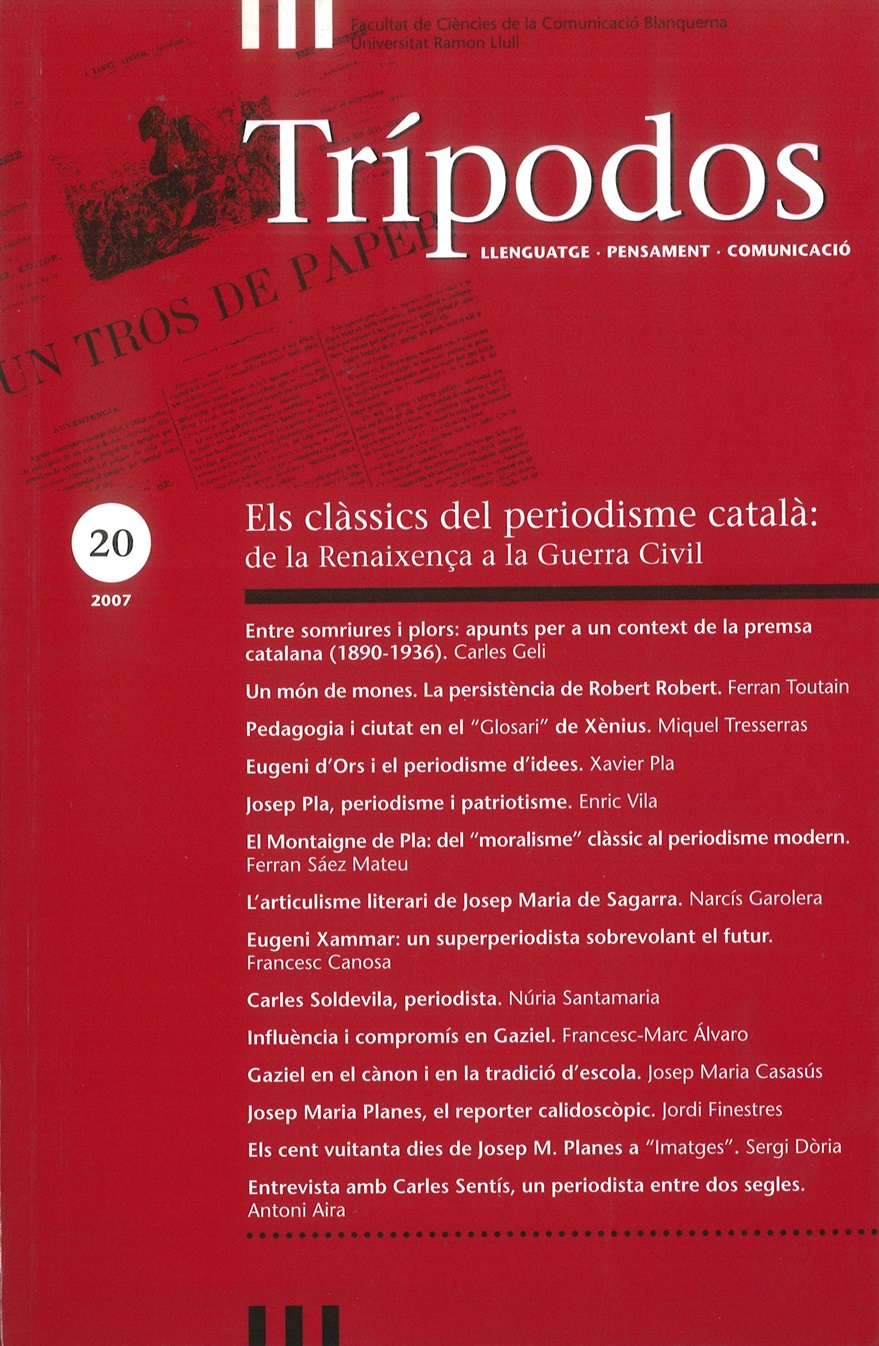
El Montaigne de Pla: del "moralisme" clàssic al periodisme modern
DOI:
https://doi.org/10.51698/tripodos.2007.20.49-62Resum
The current concept of “moralism”, or even of the term “moral”, has undergone a complex semantic evolution which started in the dying moments of the ancient world and continues today. The turning point of this transformation can be found in the work of Michel de Montaigne (1533-1592), whom great academics such as Hugo Friedrich described as “post-antique”. Some authors of the 20th century, such as Pla and Zweig, revived or accepted the perspective of Montaigne. For obvious reasons, this revival turned out to be wrong, in that it juxtaposed two nearly contradictory meanings of the concept of “moral”. This confusion has generated some extraordinarily erroneous writing about the nature and, above all, the intentions of writers such as Josep Pla. In this article we include texts that show the danger of juxtaposing the two meanings of the word “moral” in the work of certain 20th century authors such as Pla.
Descàrregues
Descàrregues
Publicades
Com citar
Número
Secció
Llicència
Drets d'autor (c) 2006 Tripodos

Aquesta obra està sota una llicència internacional Creative Commons Reconeixement-NoComercial-CompartirIgual 4.0.
Una vegada aprovat l'article per a la seva publicació a Trípodos els drets exclusius de l'edició passen a ser propietat de la Facultat de Comunicació i Relacions Internacionals Blanquerna de la Universitat Ramon Llull. Aquests drets es podran cedir a tercers sempre amb l'acord de l'autor/s.
Fins que els articles no han estat aprovats per la seva publicació la Facultat de Comunicació i Relacions Internacionals Blanquerna de la Universitat Ramon Llull no disposa de cap dret sobre ells.
L'enviament dels articles s'entén com un consentiment explicit a aquestes condicions de publicació.


