
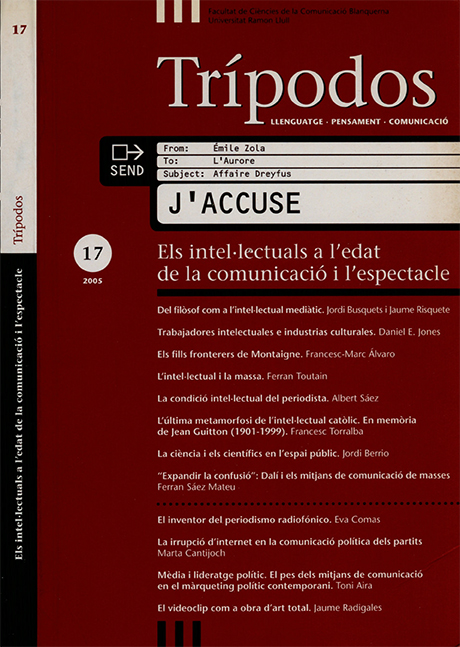
"Expandir la confusió": Dalí i els mitjans de comunicació de masses
DOI:
https://doi.org/10.51698/tripodos.2005.17.131-140Abstract
In this article, we attempt to demonstrate that the close relationship of Salvador Dalí with the mass media of the 20th century, in particular with regard to the construction of the character who would go on to worldwide fame, dates to long before his public activity as a painter. In fact, as we learn from the reading of My Personal Impressions and Memories. A diary: 1919-1920, it was the adolescent Dalí who, at only 16 years ofage, undertook a life project which was only viable, or at any rate plausible, within the context of the media. In consequence, the well-known commonplace that Dalí had intuited the media's immense power of personal promotion during his long stay in the United States is seen to be uniounded. The origin of this idea probably cornes from the later critique of the French surrealists led by Breton. Dali's artistic and life project, conceived or imagined while he was still attending school in 1919, derived from a vefy clear awareness of the new role that the media would eventually play after World War I.
Downloads
Downloads
Published
How to Cite
Issue
Section
License
Copyright (c) 2005 Tripodos

This work is licensed under a Creative Commons Attribution-NonCommercial-ShareAlike 4.0 International License.
Once an article has been approved for publication in Tripodos, the exclusive right to publish the work becomes the property of Blanquerna School of Communication and International Relations of Ramon Llull University. These rights can be granted to a third party with the agreement of the author(s).
Until the articles have been approved for publication, Blanquerna School of Communication and International Relations of Ramon Llull University has no rights over them.
The submission of articles is understood to represent explicit consent to these conditions of publication.


