
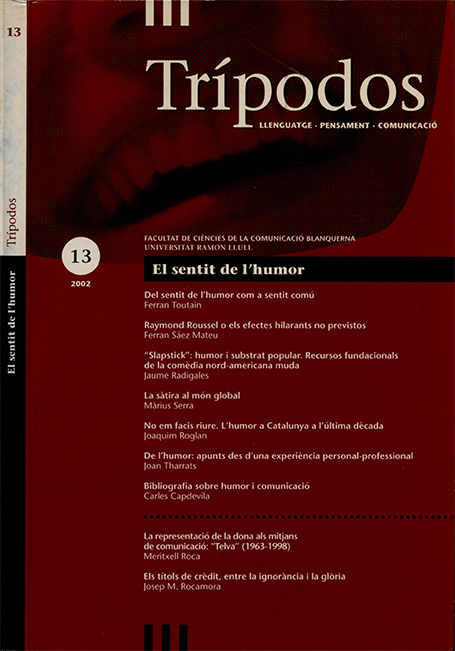
Del sentit de l'humor com a sentit comú
DOI:
https://doi.org/10.51698/tripodos.2002.13.9-22Abstract
Taking as a reterence the observations made about the phenomenon of laughter by some oï the most important thinkers in the western tradition, this article attempts to distinguish between comedy in general and that which is commonly called a sense of humor. This faculty, according to Shaftesbury, must be considered to be a farm of common sense and is, thus, closer to thought than to emotion. To develop this line of thought, the article reviews the ideas of Octavio Paz, Milan Kundera and Luigi Pirandello about the modernity ot humor and the attributes which define it, and demonstrates the formal characteristics of comedy -what makes us laugh and why- starting from the theories otHutcheson, Kant, Schopenhauer and Bergson. All of these considerations lead to the condusion that, if laughter can be provoked by the simple perception o{ incongruity, a sense of humor, which can be either empathetic or hostile, always implies reflection about the meaning of the incongruity. Or, in terms of Bergson's criteria, about the lack of common sense which a human being demonstrates when acting as a mechanical object.
Downloads
Downloads
Published
How to Cite
Issue
Section
License
Copyright (c) 2002 Tripodos

This work is licensed under a Creative Commons Attribution-NonCommercial-ShareAlike 4.0 International License.
Once an article has been approved for publication in Tripodos, the exclusive right to publish the work becomes the property of Blanquerna School of Communication and International Relations of Ramon Llull University. These rights can be granted to a third party with the agreement of the author(s).
Until the articles have been approved for publication, Blanquerna School of Communication and International Relations of Ramon Llull University has no rights over them.
The submission of articles is understood to represent explicit consent to these conditions of publication.


